 Image 1 of 1
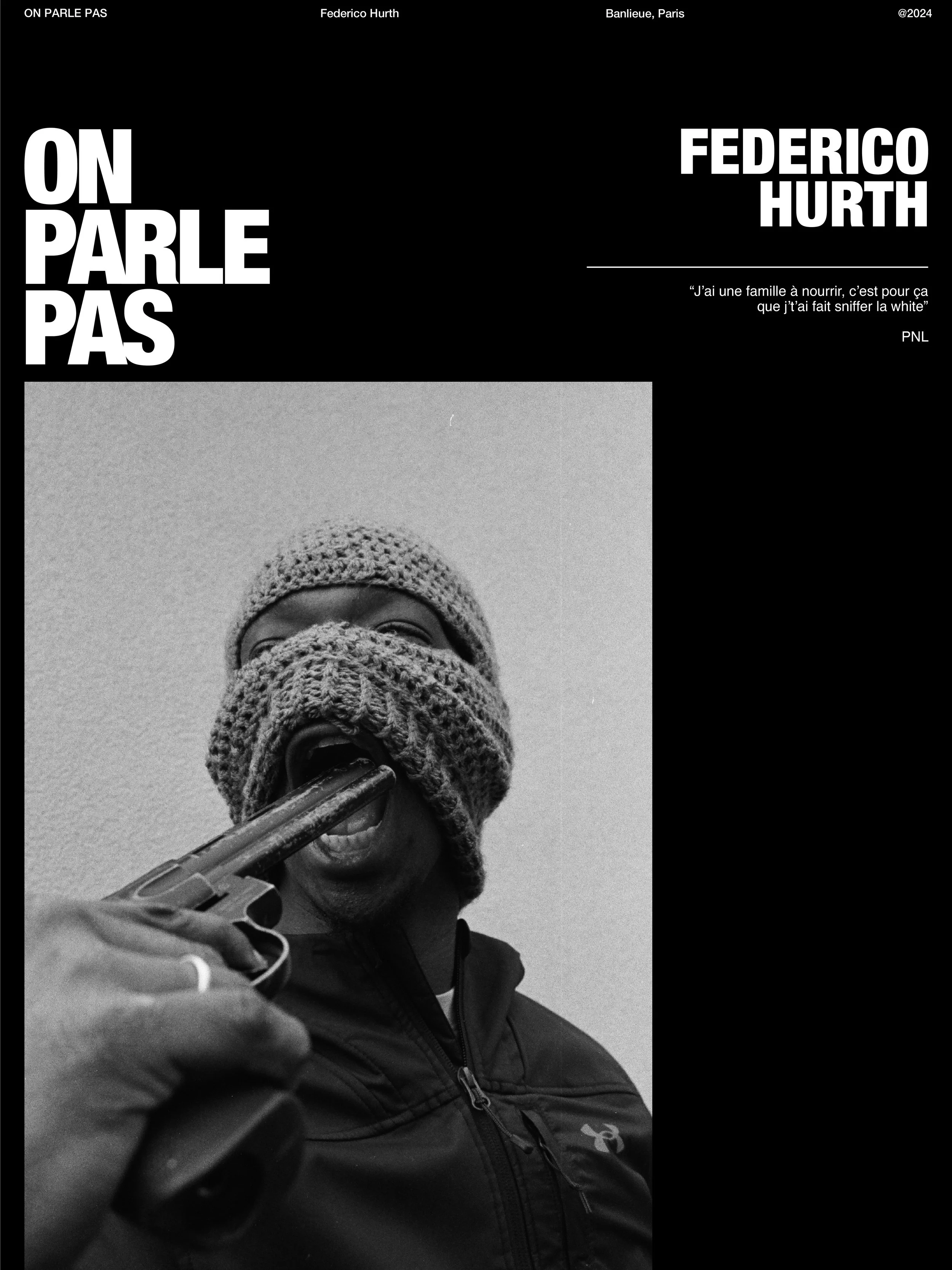
On Parle Pas
Limited Edition 100 Copies
Italiano:
La fotografia in bianco e nero consente di rivelare emozioni, riflettere personalità, rendere stati d'animo. Oppure, all'opposto, può armare il fotografo che vuole cogliere l'eloquenza delle cose, prima che sentimento e giudizio ne sfumino i contorni. L'obbiettivo di Federico Hurth si cala nella normalità cruda e violenta delle banlieue, ne osserva e documenta le presenze. Un'incursione di 12 ore tra i grigi e freddi palazzi dei sobborghi parigini di Aulnay-sous-Bois (93) e Saint-Ouen l’Aumône (95), per ritrarre la normalità violenta di un mondo a parte.
Nelle banlieue, la criminalità è diffusa tanto quanto la disoccupazione e la tossicodipendenza. Si è accolti da un'atmosfera stranamente mite, in cui, tra edifici tristi e trascurati, si muove un'umanità assente, indifferente tra giochi di bambini, borse della spesa, armi, droga. La violenza, ubiqua anche quando non visibile, muove relazioni, stabilisce gerarchie e governa gli interessi criminali. Intorno ad essa scorre la vita, con le sue abitudini, i suoi nuclei famigliari, le tradizioni, i riti, gli amori, i sogni, le speranze. Pochi sorrisi nei volti dei ragazzi, cresciuti prima del loro tempo. Poche opportunità di emergere; il calcio, per chi ha talento e fortuna, le armi per tanti, la fuga, per alcuni.
Nel lato oscuro di questo mondo vige una regola, che è diventata segno d'appartenenza: on parle pas. "OPP" è una gang, un simbolo, un credo scritto sui muri, e ha dato il titolo a questo progetto fotografico. A Federico è stato concesso di incontrare per mezza giornata ragazzi disposti a raccontarsi per immagini, attraverso le loro pose e le loro armi. Dealers, aspiranti rappers, fedeli osservanti della Regola. Immersi nel loro mondo, le loro certezze esibite. Forse nascondono qualche pensiero ribelle, che li porta brevemente fuori da questa realtà. Ma, anche di questo, on parle pas.
English:
Black and white photography is unique in its ability to convey emotions, reflect personalities, and capture states of mind. Beyond this, it can also empower the photographer, who seeks to behold the poetry of things, before feelings and judgement blur their lines. Federico Hurth's lens lifts the veil on the raw and often violent normality of the banlieue, observing and documenting its very essence. Venturing for over half a day among the grey and benumbed buildings of the Parisian suburbs of Aulnay-sous-Bois (93) and Saint-Ouen l’Aumône (95), aiming to portray the harsh reality of a dislocated world.
In the banlieue, crime is as commonplace as unemployment and drug addiction. One is greeted by a forebodingly mild atmosphere, where among gloomy and neglected buildings, an absent, indifferent humanity moves amongst children’s toys, grocery bags, guns and drugs. Violence, even when behind the scenes, shapes relationships, forms hierarchies, and drives criminal interests. Life flows around all of this, with its habits, family units, traditions, rituals, loves, dreams, and hopes. Few smiles though grace the faces of the youngsters, who have grown up prematurely. Few opportunities to emerge beyond this; football, for those few with talent and luck, weapons for many, escape for some.
In this shadowy realm, one rule reigns supreme, a mark of belonging: on parle pas. "OPP" not only stands for a gang, but it is a symbol, a creed scrawled on walls, and it lends its name to this photography project. Federico was granted a brief encounter, half a day with youngsters willing to tell their stories captured in images, through their poses and their weapons. Dealers, aspiring rappers, steadfast adherents to the Rule. Immersed in their reality, their convictions laid bare. Perhaps they harbour rebellious thoughts, which briefly take them away from this reality. Yet, again, on parle pas.
Limited Edition 100 Copies
Italiano:
La fotografia in bianco e nero consente di rivelare emozioni, riflettere personalità, rendere stati d'animo. Oppure, all'opposto, può armare il fotografo che vuole cogliere l'eloquenza delle cose, prima che sentimento e giudizio ne sfumino i contorni. L'obbiettivo di Federico Hurth si cala nella normalità cruda e violenta delle banlieue, ne osserva e documenta le presenze. Un'incursione di 12 ore tra i grigi e freddi palazzi dei sobborghi parigini di Aulnay-sous-Bois (93) e Saint-Ouen l’Aumône (95), per ritrarre la normalità violenta di un mondo a parte.
Nelle banlieue, la criminalità è diffusa tanto quanto la disoccupazione e la tossicodipendenza. Si è accolti da un'atmosfera stranamente mite, in cui, tra edifici tristi e trascurati, si muove un'umanità assente, indifferente tra giochi di bambini, borse della spesa, armi, droga. La violenza, ubiqua anche quando non visibile, muove relazioni, stabilisce gerarchie e governa gli interessi criminali. Intorno ad essa scorre la vita, con le sue abitudini, i suoi nuclei famigliari, le tradizioni, i riti, gli amori, i sogni, le speranze. Pochi sorrisi nei volti dei ragazzi, cresciuti prima del loro tempo. Poche opportunità di emergere; il calcio, per chi ha talento e fortuna, le armi per tanti, la fuga, per alcuni.
Nel lato oscuro di questo mondo vige una regola, che è diventata segno d'appartenenza: on parle pas. "OPP" è una gang, un simbolo, un credo scritto sui muri, e ha dato il titolo a questo progetto fotografico. A Federico è stato concesso di incontrare per mezza giornata ragazzi disposti a raccontarsi per immagini, attraverso le loro pose e le loro armi. Dealers, aspiranti rappers, fedeli osservanti della Regola. Immersi nel loro mondo, le loro certezze esibite. Forse nascondono qualche pensiero ribelle, che li porta brevemente fuori da questa realtà. Ma, anche di questo, on parle pas.
English:
Black and white photography is unique in its ability to convey emotions, reflect personalities, and capture states of mind. Beyond this, it can also empower the photographer, who seeks to behold the poetry of things, before feelings and judgement blur their lines. Federico Hurth's lens lifts the veil on the raw and often violent normality of the banlieue, observing and documenting its very essence. Venturing for over half a day among the grey and benumbed buildings of the Parisian suburbs of Aulnay-sous-Bois (93) and Saint-Ouen l’Aumône (95), aiming to portray the harsh reality of a dislocated world.
In the banlieue, crime is as commonplace as unemployment and drug addiction. One is greeted by a forebodingly mild atmosphere, where among gloomy and neglected buildings, an absent, indifferent humanity moves amongst children’s toys, grocery bags, guns and drugs. Violence, even when behind the scenes, shapes relationships, forms hierarchies, and drives criminal interests. Life flows around all of this, with its habits, family units, traditions, rituals, loves, dreams, and hopes. Few smiles though grace the faces of the youngsters, who have grown up prematurely. Few opportunities to emerge beyond this; football, for those few with talent and luck, weapons for many, escape for some.
In this shadowy realm, one rule reigns supreme, a mark of belonging: on parle pas. "OPP" not only stands for a gang, but it is a symbol, a creed scrawled on walls, and it lends its name to this photography project. Federico was granted a brief encounter, half a day with youngsters willing to tell their stories captured in images, through their poses and their weapons. Dealers, aspiring rappers, steadfast adherents to the Rule. Immersed in their reality, their convictions laid bare. Perhaps they harbour rebellious thoughts, which briefly take them away from this reality. Yet, again, on parle pas.